What’s Observed Today
Born Today: Libra ♎
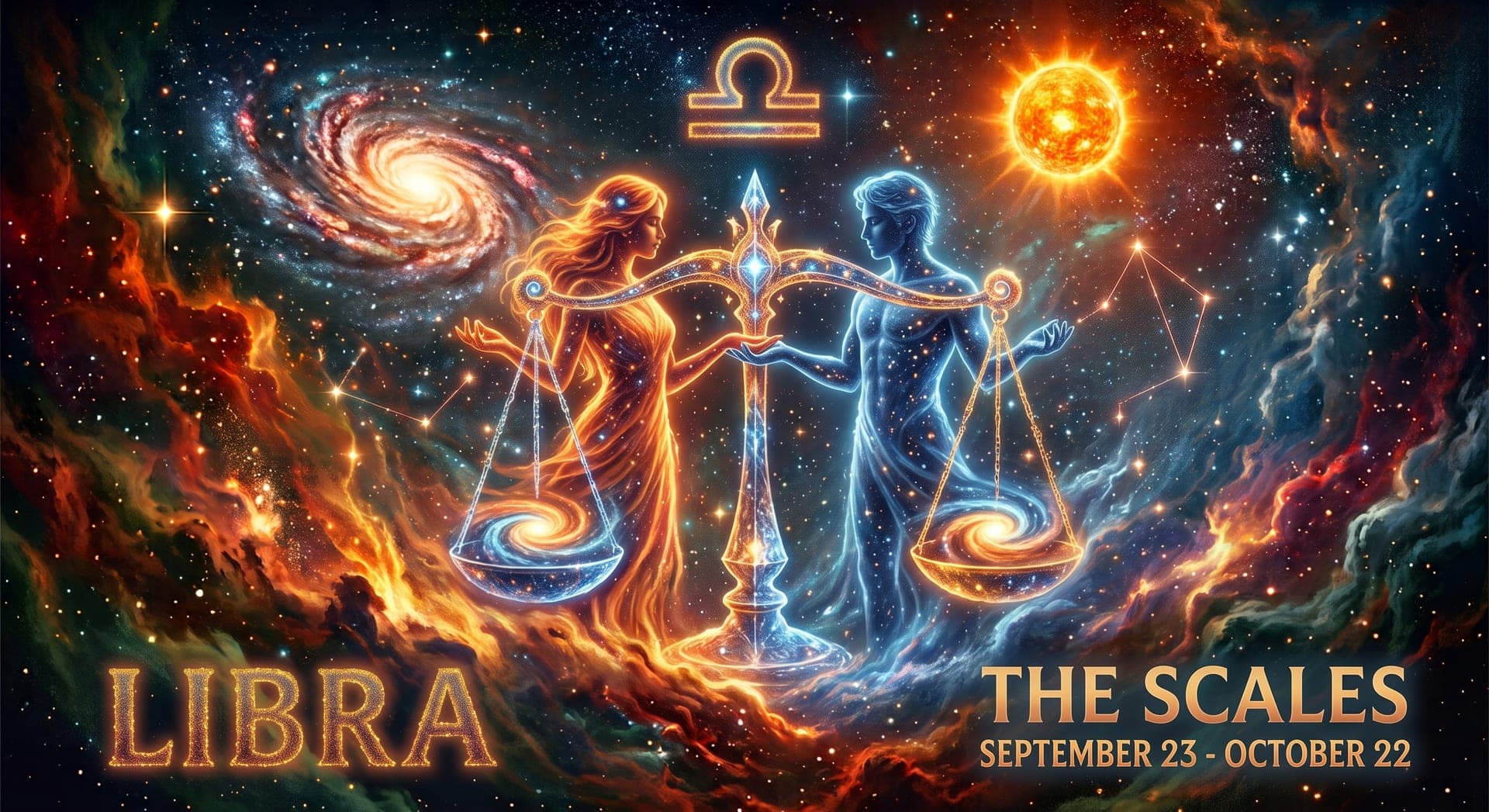
Libra, the seventh sign of the zodiac, spans September 23 to October 22 and is symbolized by the scales, the only zodiac symbol representing an inanimate object rather than a living creature, reflecting the sign's deep concern with balance, fairness, and justice. Ruled by Venus, the planet of love and beauty, Libra shares Taurus's appreciation for aesthetics and pleasure but channels it primarily through relationships, partnership, and social harmony. As an Air sign, Libra approaches the world intellectually and socially, valuing thoughtful conversation and diplomatic problem-solving over confrontation. Its Cardinal modality places it at the very start of autumn, beginning right at the equinox when day and night briefly achieve perfect balance. People born under this sign are often natural mediators, drawn to fairness and equilibrium in their relationships and surroundings, sometimes to the point of struggling to make decisions that might upset that balance. Libra's charm, diplomacy, and genuine desire to see all sides of an issue make it a valued friend and partner, even as its conflict-avoidance can occasionally leave real problems unresolved.
Personality Traits
Strengths
- Strong sense of fairness and justice
- Diplomatic peacemaker
- Charming and sociable
- Appreciates beauty and harmony
- Excellent at seeing multiple perspectives
Weaknesses
- Notoriously indecisive
- Conflict-avoidant to a fault
- Can be superficial
- People-pleasing tendencies
- Struggles with confrontation
Compatible Signs
Fun Facts
- Libra is the only zodiac sign represented by an inanimate object, the scales, rather than an animal or person.
- Libra's scales symbolize balance and justice, echoing the sign's association with fairness, harmony, and diplomacy.
- Venus, Libra's ruling planet, gives the sign its love of beauty, art, and romantic partnership, similar to Taurus but expressed through relationships rather than material comfort.
- As a Cardinal sign, Libra initiates autumn, beginning at the September equinox, when day and night are of equal length, fitting for a sign obsessed with balance.
- Notable Libras include Mahatma Gandhi, Kim Kardashian, John Lennon, and Will Smith.
Born Today
- 1452
Richard III of England
King of England from 1483 to 1485, whose brief and controversial reign ended at the Battle of Bosworth Field, the last English king to die in battle.
- 1718
Elizabeth Montagu
English author, literary critic and social reformer known as the "Queen of the Blue Stockings" for hosting influential intellectual salons in 18th-century London.
- 1852
William Ramsay
Scottish chemist who discovered the noble gases and won the 1904 Nobel Prize in Chemistry.
- 1869
Mahatma Gandhi
Indian independence leader known for nonviolent civil disobedience
- 1890
Groucho Marx
American comedian and member of the Marx Brothers
- 1904
Lal Bahadur Shastri
Prime Minister of India
- 1904
Graham Greene
English novelist and playwright celebrated for morally complex works such as The Third Man and The Power and the Glory.
- 1921
Robert Runcie
English clergyman who served as Archbishop of Canterbury during a turbulent period that included the Falklands War and internal Anglican debates over women's ordination.
- 1933
John Gurdon
English developmental biologist who shared the 2012 Nobel Prize in Physiology or Medicine for discoveries showing mature cells can be reprogrammed into stem cells.
- 1945
Don McLean
American singer-songwriter known for "American Pie"
- 1948
Trevor Brooking
English footballer who spent his entire playing career at West Ham United and later became a prominent figure in English football administration.
- 1949
Annie Leibovitz
American portrait photographer
- 1951
Sting
English singer-songwriter, bassist and actor who rose to fame as frontman of The Police before a long solo career.
- 1970
Kelly Ripa
American actress and talk show host
On This Day in History
- 939
Otto I of Germany defeats a rebellion of Frankish dukes at the Battle of Andernach.
Otto I, seeking to consolidate royal authority over rebellious regional dukes, led German royal forces to victory over Frankish rebels at Andernach along the Rhine River, a triumph that helped strengthen his position ahead of his eventual coronation as Holy Roman Emperor decades later. The victory reinforced centralized royal power at a time when regional nobles frequently challenged monarchical authority.
- 1187
Saladin captures Jerusalem after the city surrenders following a prolonged siege.
After defeating Crusader forces at the Battle of Hattin months earlier, Saladin's army besieged Jerusalem, and the Christian defenders, lacking sufficient troops to hold the city, negotiated a surrender that allowed most residents to leave safely upon payment of ransom. Saladin's relatively merciful treatment of the city's population, contrasting with the brutal massacre that had accompanied the Crusaders' original 1099 capture of Jerusalem, drew notice even from Christian chroniclers.
- 1187
Jerusalem surrendered to Saladin's forces after a siege, ending nearly ninety years of Crusader rule over the city.
The fall of the Crusader-held city to the Ayyubid sultan shocked Europe and prompted Pope Gregory VIII to call for the Third Crusade. Saladin's comparatively lenient terms, allowing residents to ransom their freedom, contrasted sharply with the massacre that had followed the city's capture by the First Crusaders in 1099.
- 1263
The Battle of Largs was fought between the forces of Norway and Scotland on the Ayrshire coast.
The battle formed part of King Haakon IV of Norway's campaign to assert control over the Hebrides and other Scottish-claimed islands. Though militarily inconclusive, the ensuing Norwegian withdrawal paved the way for the 1266 Treaty of Perth, in which Norway ceded the Hebrides and Isle of Man to the Kingdom of Scotland.
- 1470
The Earl of Warwick's uprising forces King Edward IV to flee England, briefly restoring Henry VI to the throne.
The powerful Earl of Warwick, once a key ally of Edward IV nicknamed "the Kingmaker" for his role in Edward's rise, turned against the king amid political disputes and led a successful uprising that forced Edward to flee to Burgundy. Warwick briefly restored the previously deposed Henry VI to the throne, though Edward returned the following year to reclaim power decisively.
- 1470
A rebellion led by the Earl of Warwick forced King Edward IV of England to flee to the Netherlands.
Richard Neville, Earl of Warwick, nicknamed "the Kingmaker," had switched allegiance from Edward IV to the Lancastrian cause, briefly restoring Henry VI to the throne. Edward's flight marked a low point in the Wars of the Roses, though he returned the following year to reclaim his crown at the battles of Barnet and Tewkesbury.
- 1552
Russian forces under Ivan the Terrible capture Kazan, ending the Khanate of Kazan.
Ivan the Terrible personally led a massive Russian army in a successful siege of Kazan, the capital of a powerful Tatar khanate that had long threatened Russian territory through raids. The conquest eliminated a major regional rival, opened Russian expansion eastward into Siberia, and is still commemorated in Russia as a significant milestone in the country's territorial consolidation.
- 1766
A riot broke out among crowds at Nottingham's Goose Fair after cheese sellers raised their prices.
Amid a broader wave of English food riots driven by poor harvests and rising prices, angry buyers pelted vendors and rolled cheese wheels through the streets in protest. The disturbance reflected the tense relationship between ordinary consumers and traders during a period of economic hardship in Georgian England.
- 1780
British officer John Andre is executed as a spy by American forces for his role in Benedict Arnold's plot.
British Major John Andre was captured carrying incriminating documents detailing American General Benedict Arnold's plot to surrender the strategic fort at West Point to British forces in exchange for money and a military commission. Despite pleas for a more honorable execution by firing squad, Andre was hanged as a spy, while Arnold himself escaped to British lines, his name becoming a lasting American synonym for treason.
- 1780
British Army officer John Andre was hanged as a spy by American forces during the Revolutionary War.
Andre had conspired with American general Benedict Arnold to hand over the fort at West Point to the British but was captured while carrying incriminating documents. His execution, conducted with considerable respect for his conduct and character, made him a celebrated martyr figure in Britain, later commemorated with a monument in Westminster Abbey.
- 1835
Mexican troops encounter armed resistance at Gonzales, Texas, in an early clash of the Texas Revolution.
Mexican soldiers attempting to reclaim a small cannon previously lent to Texian settlers for defense against Comanche raids were met by armed colonists flying a flag reading "Come and Take It," resulting in a brief skirmish that produced few casualties but carried enormous symbolic weight. The confrontation is traditionally regarded as the opening engagement of the Texas Revolution against Mexican rule.
- 1870
Italian citizens vote to annex the Papal States into the Kingdom of Italy.
Following Italian troops' capture of Rome weeks earlier during the final phase of Italian unification, a plebiscite of Roman citizens overwhelmingly approved joining the new Kingdom of Italy, ending over a thousand years of papal temporal rule over the city. Pope Pius IX refused to recognize the annexation, considering himself a "prisoner" in the Vatican, a dispute not resolved until 1929.
- 1919
President Woodrow Wilson suffers a severe stroke at the White House.
President Wilson suffered a massive stroke that left him partially paralyzed and largely incapacitated for the remainder of his term, a condition that was significantly concealed from the American public and even much of his own cabinet by his wife, Edith Wilson, who effectively managed many presidential duties during his prolonged recovery, raising enduring questions about presidential succession and disability.
- 1942
The British liner RMS Queen Mary accidentally rammed and sank the Royal Navy cruiser HMS Curacoa off the coast of Scotland.
While serving as a troopship carrying thousands of American soldiers, the Queen Mary was under strict orders not to stop or divert for any escort vessel, since U-boats posed the greater threat. The collision killed 239 of Curacoa's crew, and, due to wartime secrecy, the disaster was not publicly disclosed until after the war.
- 1967
Thurgood Marshall was sworn in as the first African-American justice of the United States Supreme Court.
A former civil rights lawyer who had successfully argued Brown v. Board of Education before the Court, Marshall was nominated by President Lyndon B. Johnson and confirmed by the Senate weeks earlier. His appointment marked a milestone in the racial integration of the highest levels of the American judiciary.
- 1968
Mexican soldiers attack unarmed student demonstrators in the Tlatelolco massacre days before the Mexico City Olympics.
Ten days before the opening of the Mexico City Olympics, government security forces opened fire on a peaceful student demonstration at the Plaza de las Tres Culturas, killing an unknown but substantial number of protesters in an act of state violence that Mexican authorities long sought to minimize or cover up, an event that became a defining trauma in modern Mexican political history.
- 1971
British European Airways Flight 706 crashed near Aarsele, Belgium, killing all 63 people on board.
The Vickers Vanguard aircraft, flying from London to Salzburg, broke apart in flight after suffering structural failure of its tailplane, likely caused by corrosion. The disaster remains one of the deadliest air accidents involving a British carrier and prompted closer scrutiny of aircraft maintenance and metal fatigue.
- 2002
The Beltway sniper attacks begin in the Washington, D.C. area, terrorizing the region for three weeks.
Two snipers operating from a modified car trunk carried out a series of seemingly random shootings across the Washington metropolitan area over three weeks, killing ten people and wounding three others while evading capture despite an intense, high-profile manhunt. The eventual arrests revealed the perpetrators as a middle-aged man and his teenage accomplice, whose motives remained disputed even after conviction.
- 2004
The first parkrun, then called the Bushy Park Time Trial, took place in Bushy Park, London.
Organised by Paul Sinton-Hewitt for a small group of friends as a free, timed 5-kilometre run, the event grew into the global parkrun movement, which now hosts weekly timed runs in thousands of parks across dozens of countries. It remains headquartered in the UK and is credited with getting millions of people into regular exercise.
- 2025
Two people were killed and several more injured in an attack on a synagogue in Manchester, England, during Yom Kippur.
The attack occurred outside the synagogue as worshippers gathered for services on the holiest day in the Jewish calendar. The assailant was shot dead by armed police, and the incident prompted a heightened security response at Jewish sites across the UK and renewed national debate over antisemitic violence.